
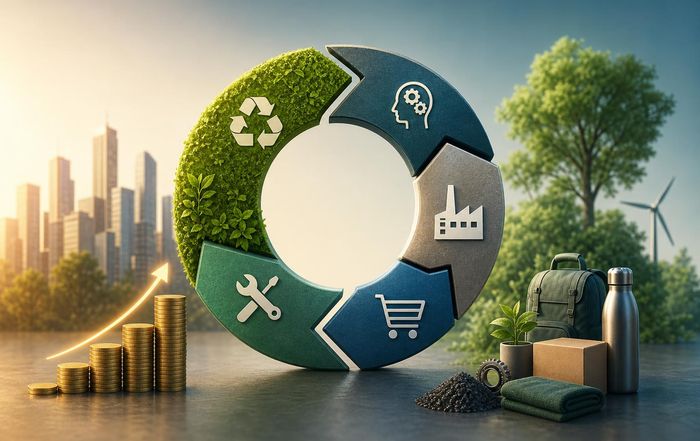
How Circular Business Models Create New Revenue Streams
Circular business models are shifting from sustainability buzzword to revenue strategy. As pressure grows from regulators, investors, and customers to reduce waste and emissions, companies are discovering that "closing the loop" can also open up new income sources, improve margins, and deepen customer relationships. Join as we look at how circular models actually generate money, which sectors are moving fastest, and what practical playbooks are emerging for businesses that want to turn environmental responsibility into commercial advantage.
From Linear to Circular: Why the Revenue Logic Changes
The traditional "take-make-waste" model is built around selling as many new units as possible, as frequently as possible. Revenue depends on volume and replacement cycles. In a circular model, value is designed to circulate for longer through reuse, repair, remanufacturing, and recycling, often supported by digital tools and service-based contracts.
The Ellen MacArthur Foundation defines the circular economy as one that is "regenerative by design," keeping products, components, and materials at their highest value for as long as possible. That shift changes the revenue logic: instead of a single sale followed by disposal, circular models create multiple monetization points over a product's life. In many industries, this also aligns with regulatory trends such as the EU's Circular Economy Action Plan and emerging "right to repair" rules in the US and Europe, which are pushing businesses to design for durability, reparability, and material recovery.
For readers focused on broader business and sustainability trends, this is not just an environmental story. It is about how new circular strategies intersect with innovation, investment, and regulation to reshape competitive advantage.
Key Circular Revenue Models Emerging Across Industries
Circularity is not one model but a family of approaches. Several archetypes have become common across sectors, each with distinct revenue mechanics and risk profiles.
Product-as-a-Service (PaaS) and "X-as-a-Service"
Instead of selling ownership, companies retain ownership and sell outcomes or access. Revenue typically comes from recurring subscription or usage fees, with the provider responsible for maintenance, upgrades, and end-of-life management.
Examples include:
Lighting-as-a-service: Philips (now Signify) pioneered models where it installs and maintains LED systems while customers pay a monthly fee for light output rather than buying fixtures outright. This creates long-term, predictable revenue and incentivizes the company to design durable, energy-efficient products that are easy to refurbish.
Equipment leasing and pay-per-use: Industrial players like Rolls-Royce with its "Power by the Hour" for aircraft engines, or Kaeser Kompressoren with compressed air as a service, charge based on uptime or usage, aligning incentives for reliability and efficient maintenance.
This model can improve margins because assets generate revenue multiple times, backed by data-driven maintenance and high residual value. However, it also requires capital to keep assets on the balance sheet and robust asset-management capabilities. For companies exploring service-based offerings, this intersects strongly with technology and IoT innovation, as sensors and connectivity are often central to making PaaS viable.
Take-Back, Trade-In, and Buy-Back Programs
Many consumer brands now offer trade-in or buy-back schemes, creating new revenue from used products while keeping materials in circulation.
Apple's trade-in program collects old devices, which are either refurbished and resold or disassembled with robots like "Daisy" to recover high-value materials. Refurbished devices are sold at premium margins because acquisition costs are relatively low.
Apparel companies such as Patagonia and The North Face run branded resale programs, selling used gear through their own channels. By controlling the secondary market, they capture value that would otherwise go to third-party resale platforms.
These programs generate revenue in several ways: resale of refurbished products, sale of recovered parts into repair networks, and material recovery for remanufacturing. They can also stimulate demand for new products when customers use trade-in credit, boosting primary sales while building loyalty.
Refurbishment, Remanufacturing, and Certified Pre-Owned
Refurbished and remanufactured products are increasingly mainstream, particularly in electronics, automotive, and industrial equipment.
The International Resource Panel has highlighted remanufacturing as a key strategy for reducing resource use while maintaining economic output, with remanufactured products often costing 30-50% less to produce than new equivalents while selling at a smaller discount to customers.
In automotive, certified pre-owned (CPO) programs by brands such as BMW, Toyota, and Mercedes-Benz generate high-margin revenue from used vehicles that undergo rigorous inspection and refurbishment. CPO cars typically sell at a premium to regular used vehicles, while still undercutting new models.
For business customers, remanufactured industrial components can offer lower total cost of ownership with warranties similar to new parts. For manufacturers, remanufacturing creates additional revenue without the full material and energy cost of new production, while also reducing exposure to raw material price volatility.
Sharing, Rental, and Access Platforms
The rise of digital platforms has enabled models where assets are shared among multiple users, increasing utilization and creating new fee-based revenue streams.
In mobility, car-sharing services (e.g., Zipcar, Share Now) and micromobility platforms (e-scooters and bikes) monetize short-term access. While some early players struggled with profitability, more recent models are focusing on fleet durability, repairability, and local operations efficiency, aligning more closely with circular principles.
Tool libraries and equipment rental services, from global firms like United Rentals to local cooperatives, generate revenue by renting tools and machinery many times over their lifespan, spreading embodied carbon and material use across multiple customers.
For companies with underutilized assets-vehicles, machinery, office space-platforms that enable secure sharing can unlock new income while reducing the need for additional production. However, profitability depends heavily on utilization rates, maintenance costs, and local regulatory conditions.
Materials Recovery and Industrial Symbiosis
Some of the most powerful circular revenue opportunities emerge at the material and ecosystem level, rather than at the individual product level.
Industrial symbiosis projects, such as the long-running example in Kalundborg, Denmark, connect multiple companies so that the by-product of one becomes the input for another. Waste heat, steam, gypsum, and other materials are sold between partners, turning waste management costs into revenue streams.
Companies specializing in advanced recycling, such as Umicore in metals recovery or Eastman in molecular recycling of plastics, generate revenue by processing waste streams into high-purity materials. As regulatory pressure grows on producers to manage end-of-life impacts-through extended producer responsibility (EPR) schemes, for example-demand for such services is increasing.
In many jurisdictions, policies like the EU's Waste Framework Directive and battery regulations are pushing manufacturers to design for recyclability and to finance collection and treatment. This regulatory backdrop is creating new business opportunities for recyclers, logistics providers, and data platforms that track material flows.
Where the Money Comes From: Revenue Levers in Circular Models
Across these models, several common revenue levers appear. Understanding them helps companies design circular strategies with a realistic business case rather than relying on broad sustainability narratives.
First, there is lifetime value expansion. When a company stays involved with a product over its full life-through maintenance, upgrades, trade-in, or resale-it can capture revenue multiple times from the same physical asset. A laptop might generate income as a new sale, a service contract, a refurbished sale, and finally as recovered materials. Each step builds on the sunk design and production cost.
Second, circular models enable new customer segments and price points. Refurbished or remanufactured products can open up value-conscious segments that might not buy new, particularly in emerging markets or among younger consumers. Certified pre-owned programs, for example, attract customers who want brand quality at a lower price, with the brand capturing margin that would otherwise go to independent dealers.
Third, there is recurring and predictable revenue. PaaS and subscription models transform lumpy one-off sales into ongoing fee streams. This can improve cash flow stability and valuation multiples, but it also requires careful risk management around asset performance and customer churn. Digital monitoring and predictive maintenance, often powered by AI and IoT, are increasingly central to making these models financially viable.
Fourth, circularity can unlock cost savings that effectively act like revenue. Lower material input needs, reduced waste disposal fees, and more efficient use of energy and water can significantly improve margins. A McKinsey & Company analysis of the circular economy in Europe estimated potential net material cost savings of up to hundreds of billions of euros annually if circular principles are widely adopted. While these savings show up on the cost side, they expand the economic space for competitive pricing, investment, or profit.
Finally, circular strategies can generate licensing and data monetization opportunities. Companies that develop proprietary remanufacturing processes, tracking technologies, or circular design methods may license them to others. Digital platforms that manage product passports or material traceability-an area gaining traction as the EU develops a Digital Product Passport framework-can monetize access to data, analytics, and compliance services.
Sector Snapshots: Where Circular Revenues Are Growing Fastest
Different industries are moving at different speeds, shaped by regulation, customer expectations, and asset economics. Several sectors stand out as proving grounds for circular revenue models.
Consumer Electronics and IT
Electronics are a natural fit for circularity because devices are high value, resource intensive, and often replaced before the end of their technical life. Trade-in, refurbishment, and certified pre-owned programs are now mainstream among leading smartphone and laptop brands.
Companies such as Apple, Samsung, and Dell have built sizable businesses around refurbished devices and components. Enterprise IT providers like HPE and Cisco run asset recovery and remanufacturing programs that generate revenue from used equipment while helping clients meet sustainability and data-security requirements.
Policy is accelerating this trend. The EU's Ecodesign for Sustainable Products Regulation aims to ensure products are more durable, repairable, and recyclable, while "right to repair" rules in Europe and several US states are making parts and documentation more accessible. This regulatory push is increasing the economic attractiveness of repair, refurbishment, and spare-parts businesses.
For readers tracking technology and innovation, this sector illustrates how design, software updates, and reverse logistics combine to create recurring revenue from a single device.
Fashion and Textiles
Fashion has been under intense scrutiny for its environmental footprint and waste. In response, brands and platforms are experimenting with resale, rental, repair, and take-back programs.
Resale platforms like ThredUp, Vestiaire Collective, and Vinted have shown that second-hand fashion can be a large, fast-growing market. In parallel, brands such as Patagonia, Levi's, and H&M have launched their own resale initiatives, sometimes in partnership with white-label technology providers. These programs generate commission or margin on pre-owned items and can drive traffic back to primary retail channels.
Clothing rental, from occasion-wear services like Rent the Runway to everyday rental in markets such as China and Europe, is another revenue pathway. While unit economics can be challenging due to logistics and cleaning costs, some operators are refining their models with better garment durability and inventory management.
As extended producer responsibility rules for textiles emerge in regions such as the EU, new revenue opportunities are likely in textile sorting, fiber-to-fiber recycling, and digital product passports that track fiber content and care instructions.
Automotive and Mobility
The automotive sector has long operated with some circular elements-used car markets, parts remanufacturing, and leasing-but electrification and digitalization are pushing new models.
Electric vehicle (EV) batteries are a focal point. Companies like Redwood Materials in the US and Northvolt in Europe are building businesses around collecting and recycling batteries to recover lithium, nickel, cobalt, and other critical materials. As EV volumes rise and regulations such as the EU's Battery Regulation tighten requirements for recycled content and end-of-life management, these services represent a growing revenue pool.
At the same time, subscription and flexible ownership models-from OEMs and startups alike-are blending leasing, maintenance, and upgrade options. Over-the-air software updates, performance unlocks, and feature subscriptions (e.g., advanced driver assistance systems) further extend revenue beyond the initial vehicle sale.
For mobility providers and automakers, circular design (durable components, modular interiors, easily replaceable batteries) supports higher utilization, lower lifetime costs, and more predictable revenue from fleets and services.
Industrial and B2B Equipment
In industrial markets, circular models are often less visible to consumers but can be highly material to earnings.
Manufacturers of heavy machinery, compressors, medical equipment, and other capital goods are expanding service and remanufacturing offerings. For example, Caterpillar has a long-standing remanufacturing business (Cat Reman) that restores used components to like-new condition, selling them at a discount with full warranty. This business captures value from core returns, stabilizes demand for new parts, and helps customers reduce costs.
Performance-based service contracts-where providers are paid for uptime, output, or efficiency-create recurring revenue and incentivize robust, repairable design. Digital twins and predictive maintenance, often using AI analytics, help optimize these contracts and reduce downtime, linking circularity closely with artificial intelligence applications in industry.
Enablers: Technology, Data, and Ecosystem Partnerships
Turning circular ambitions into revenue requires more than a new marketing message. It depends on technology, data, and collaboration across value chains.
Digital technologies are central. IoT sensors, connectivity, and cloud platforms enable real-time monitoring of asset condition and usage, making PaaS and pay-per-use models manageable at scale. Data on performance and failure modes feeds back into design, improving durability and ease of repair. Product lifecycle management (PLM) systems and enterprise software increasingly integrate circular metrics, helping companies track assets and materials.
Traceability and transparency are also crucial. Regulators, investors, and customers increasingly expect companies to prove claims about recycled content, ethical sourcing, and end-of-life outcomes. Blockchain-based solutions, digital product passports, and standardized reporting frameworks-such as those discussed by the World Economic Forum in its circularity and traceability initiatives-are emerging to support this.
Ecosystem partnerships matter because no single company can close the loop alone. Brands are collaborating with logistics providers, recyclers, repair networks, and digital platforms to manage returns, refurbishment, and material recovery. Industry alliances and cross-sector initiatives are helping define standards, invest in shared infrastructure, and develop new business models.
For readers interested in global business dynamics, these partnerships highlight how circularity is reshaping supply chains and creating new roles for intermediaries, from specialized refurbishers to data-driven materials marketplaces.
Risks, Trade-Offs, and Common Pitfalls
Circular models are not automatically profitable or risk-free. Companies that rush in without a grounded business case can face financial and reputational challenges.
One key risk is capital intensity and balance-sheet exposure. PaaS and leasing models require companies to own assets longer, tying up capital and increasing exposure to residual value risk if technology changes quickly or demand shifts. Careful scenario planning, modular design, and secondary markets for used assets are essential to mitigate these risks.
Another challenge is operational complexity. Managing reverse logistics, refurbishment, and quality control at scale can be demanding. Without robust processes and data, costs can erode margins. Many early experiments in fast-fashion rental or low-cost electronics refurbishment struggled because logistics, repair, and customer service costs were underestimated.
There is also the danger of greenwashing. As circularity becomes a marketing theme, some companies highlight minor recycling initiatives or token take-back schemes without meaningful impact on design, business models, or revenue. Regulators are responding: the EU is advancing rules against misleading environmental claims, and competition authorities in several countries have scrutinized sustainability advertising. Overstating circular achievements can backfire, damaging trust with consumers and investors.
Finally, circular strategies must navigate regulatory and market uncertainty. Policy frameworks are evolving rapidly, from EPR schemes to product standards and trade rules. At the same time, customer acceptance of refurbished, remanufactured, or subscription-based offerings varies by culture and segment. Companies need to test, iterate, and adapt models to local conditions rather than assuming one-size-fits-all.
Practical Steps for Businesses Exploring Circular Revenue
For leaders considering how to move beyond pilots and press releases, several pragmatic steps can help turn circular ideas into viable revenue streams.
First, start with product and portfolio mapping. Identify which products have high residual value, long technical lifespans, or strong secondary markets. These are prime candidates for refurbishment, remanufacturing, or PaaS models. In parallel, assess where waste disposal costs, material price volatility, or regulatory pressure are highest; these pain points often indicate where circular strategies will have the strongest business case.
Second, build a data foundation. Track where products go after sale, failure patterns, and repair histories. This may require new customer engagement, warranties, or digital features (such as connected devices that report usage). Data is essential to price service contracts, forecast residual values, and design logistics for returns.
Third, experiment with focused pilots rather than wholesale transformation. A trade-in program for a single product line, a remanufactured offering for a particular component, or a PaaS contract with a limited set of customers can test assumptions and refine operations. Success in one segment can then be scaled or adapted elsewhere.
Fourth, invest in design for circularity. Modularity, standardized parts, accessible fasteners, and durable materials can dramatically reduce refurbishment and repair costs, improving the economics of circular models. Cross-functional collaboration between design, engineering, procurement, and service teams is crucial.
Finally, communicate clearly and credibly. Customers need to understand the value proposition of refurbished products, subscriptions, or take-back schemes-not only in environmental terms but in reliability, convenience, and cost. Transparent warranties, performance guarantees, and clear messaging help build trust.
Individuals interested in the broader business and economy context may also watch how investors integrate circularity into ESG analysis and capital allocation, shaping which companies can access financing for these transitions.
Why Circular Revenue Models Matter for Competitive Strategy
Circular business models are often framed as a response to environmental pressure. They are that-but they are also becoming a strategic response to structural shifts in the global economy: resource constraints, regulatory tightening, digitalization, and changing customer expectations.
Companies that successfully embed circularity into their revenue models can reduce dependency on volatile raw material markets, differentiate offerings, and create more resilient, service-oriented income streams. Those that delay may find themselves locked into linear cost structures and exposed to rising compliance and disposal costs.
For business leaders, investors, and people following global economic trends, the key question is no longer whether circular models will matter, but where in each value chain they will create the most sustainable revenue. The organizations that answer that question early-and back it with operational capability-are likely to shape the next wave of profitable, low-carbon growth.
