
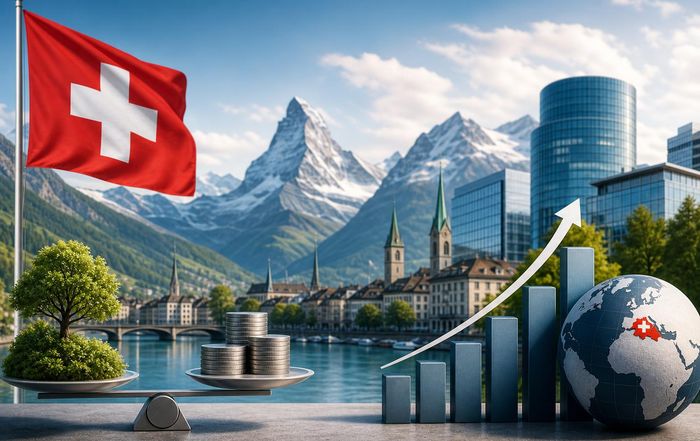
How Switzerland Balances Growth and Stability in Its Business Economy
Switzerland's economy is often treated as a benchmark for how to combine prosperity, resilience, and social cohesion. For investors, founders, and policymakers, the country offers a live case study in how an advanced economy can grow steadily without sacrificing financial stability, institutional trust, or social safety nets. Understanding how Switzerland does this is increasingly relevant as many larger economies grapple with higher public debt, volatile inflation, geopolitical shocks, and rapid technological change.
We’re glad you chose to spend part of your day here, we think you're gonna love reading the rest of this!
A Small, Open Economy With Outsized Global Influence
Switzerland is a relatively small country of around 9 million people, but it consistently ranks among the world's richest nations by GDP per capita. According to the World Bank, Swiss GDP per capita in 2023 was among the highest globally, reflecting both high productivity and a strong services sector. The economy is highly open: exports of goods and services account for more than half of GDP, with pharmaceuticals, machinery, precision instruments, and financial services leading the way.
This openness makes Switzerland deeply exposed to global economic cycles, yet its performance has been comparatively stable. During the global financial crisis, the eurozone debt crisis, and the COVID-19 pandemic, Switzerland experienced downturns but avoided the more severe contractions seen in several European neighbors. The Swiss State Secretariat for Economic Affairs (SECO) reports that long-run growth has been modest but steady, with low volatility and relatively quick recoveries from shocks. That pattern-moderate growth rather than spectacular booms, but fewer deep busts-is central to the country's economic model.
Financially aware people interested in broader macro trends can compare this with our unique reporting of global economy developments and how other advanced markets manage similar trade-offs.
Monetary Policy: A Conservative Central Bank in a Volatile World
The Swiss National Bank (SNB) is one of the most influential actors in Switzerland's balance between growth and stability. Its mandate is to ensure price stability while taking economic developments into account. Historically, that has meant a firm stance against sustained inflation and a willingness to tolerate a strong currency, even when this hurts exporters in the short term.
In the 2010s, Switzerland became a laboratory for negative interest rates. To counter safe-haven capital inflows and prevent excessive appreciation of the Swiss franc, the SNB cut its policy rate below zero in 2015 and maintained negative rates for years. At the same time, it intervened heavily in foreign exchange markets, accumulating large foreign currency reserves. This approach was controversial, but it kept inflation low and helped avoid a deflationary spiral.
As global inflation surged after the pandemic, the SNB joined other central banks in raising rates from 2022 onward. By mid-2024 it had begun cautiously reversing some of those hikes as Swiss inflation returned towards its target range, according to SNB communications and inflation data published by the bank. The central bank's willingness to move early, both into and out of unconventional policies, reflects a broader Swiss preference for pre-emptive risk management rather than crisis firefighting.
For readers following global monetary trends, this contrasts with the approaches of the European Central Bank and the U.S. Federal Reserve, both of which faced more pronounced inflation spikes and political scrutiny. The Swiss case illustrates how a small, independent central bank can act aggressively to preserve stability, even when doing so is unpopular with parts of the business community.
Banking and Financial Services: From Secrecy to Global Standards
Switzerland's reputation has long been tied to its financial sector. Zurich and Geneva remain key global hubs for private banking, asset management, and insurance. Yet the foundations of Swiss banking have changed significantly in the last 15 years, with important implications for both growth and stability.
Historically, strict bank secrecy laws attracted global wealth but also drew criticism over tax evasion and money laundering. Under international pressure, Switzerland signed on to the OECD's Common Reporting Standard and gradually dismantled traditional secrecy in cross-border tax matters. Banks now routinely share client information with foreign tax authorities, and the regulatory framework has become more aligned with international standards.
At the same time, the sector has faced structural challenges. Low and negative interest rates compressed margins for traditional banking, while the 2023 collapse of Credit Suisse and its emergency takeover by UBS was a defining moment. The Swiss Financial Market Supervisory Authority (FINMA) and the government orchestrated a rapid rescue to prevent systemic contagion, but the episode raised serious questions about risk management, governance, and the concentration of financial power in a single, very large institution.
For a closer look at how banking systems evolve under pressure, see our broader banking coverage and analysis of regulatory reforms in other markets.
Despite these shocks, Switzerland's financial sector remains a major contributor to GDP, employment, and exports. According to SwissBanking, the industry association, financial services account for roughly 9% of GDP and a significant share of federal tax revenues. Stability today is less about secrecy and more about capital strength, liquidity, and regulatory oversight. The shift illustrates how a country can preserve a high-value sector while adapting to new governance expectations.
Innovation, Industry, and the Mittelstand-Style Backbone
Switzerland's economic model is often associated with banking and pharmaceuticals, but its industrial base is broader and more diversified. A dense layer of small and medium-sized enterprises (SMEs) in precision engineering, machinery, specialty chemicals, and advanced manufacturing underpins export strength and regional employment.
This SME sector resembles the German Mittelstand: many firms are family-owned, highly specialized, export-oriented, and conservative in their financing. They tend to reinvest profits for long-term competitiveness rather than chase rapid expansion. This cautious corporate culture supports stability but does not prevent innovation. On the contrary, Switzerland regularly ranks at or near the top of the Global Innovation Index, published by the World Intellectual Property Organization (WIPO), thanks to strong spending on research and development, dense collaboration between universities and industry, and a high share of knowledge-intensive exports.
Major companies such as Roche, Novartis, Nestlé, ABB, and Holcim anchor global value chains from Swiss headquarters. At the same time, the country has a growing ecosystem of startups in sectors like biotech, medtech, robotics, and fintech. Cities such as Zurich, Lausanne, and Basel benefit from proximity to world-class universities like ETH Zurich and EPFL, which are ranked among the top engineering and technology institutions worldwide by sources such as the QS World University Rankings.
Readers tracking the intersection of innovation and technology will find Switzerland's emphasis on applied research, vocational excellence, and public-private partnerships an instructive counterpoint to more purely venture-capital-driven ecosystems.
The Role of Education and Vocational Training
A distinguishing feature of Switzerland's model is its emphasis on skills, particularly the dual vocational education and training (VET) system. After compulsory schooling, a large share of young people enter apprenticeships that combine classroom instruction with on-the-job training in companies. According to the Swiss Federal Institute for Vocational Education and Training (SFIVET) and OECD analyses, this system covers two-thirds or more of upper-secondary students and is a major reason for Switzerland's low youth unemployment rate.
For businesses, the VET system ensures a steady pipeline of well-trained workers in trades, technical occupations, and services. For the economy, it helps align skills with labor market needs, reducing structural unemployment and social tensions. The system also supports social mobility by offering multiple paths into higher education or advanced professional roles, rather than a strict divide between academic and non-academic tracks.
This focus on human capital complements Switzerland's high R&D spending and contributes to its strong productivity performance. It also resonates with ongoing debates in many countries about the future of work, automation, and the need to retrain workers as artificial intelligence and digital technologies reshape job profiles. For those following labor market trends, our employment coverage frequently touches on how skills systems adapt to technological change.
Fiscal Discipline, Federalism, and the "Debt Brake"
On the fiscal side, Switzerland stands out for its relatively low public debt and disciplined budget framework. The federal government operates under a "debt brake" (Schuldenbremse), a constitutional rule introduced in the early 2000s that links spending to cyclical-adjusted revenues. In practice, this means that deficits in downturns must be offset by surpluses in better years, limiting the build-up of structural deficits.
According to Swiss Federal Finance Administration data and comparisons by the International Monetary Fund (IMF), Swiss public debt as a share of GDP is significantly lower than in many advanced economies, including the United States, Japan, and several large EU countries. This lower debt burden gives Switzerland more fiscal room to respond to crises, as seen during the COVID-19 pandemic when the government rolled out sizeable support measures-such as short-time work schemes and liquidity assistance for firms-without triggering concerns about solvency.
Federalism also shapes economic policy. Switzerland's 26 cantons have considerable autonomy over taxation and spending. This creates a degree of tax competition within the country, with some cantons offering lower corporate and personal tax rates to attract businesses and high-income residents. While critics argue that this can fuel inequality between regions, supporters say it encourages efficiency and responsiveness. In practice, inter-cantonal equalization schemes and federal transfers help mitigate imbalances.
For investors and companies considering Switzerland as a base, this combination of fiscal stability and decentralized decision-making offers both predictability and flexibility. It also illustrates how a country can maintain a competitive tax environment without abandoning budget discipline-an issue frequently explored in our business and investment coverage.
Managing a Strong Currency and Export Competitiveness
One of the most persistent challenges for Switzerland is its strong currency. The Swiss franc is seen as a safe haven, attracting capital in times of global stress. While this reinforces financial stability and keeps imported inflation low, it also makes Swiss exports more expensive on world markets.
To manage this tension, Swiss firms have pursued several strategies. Many focus on high-value, niche products where quality and reliability matter more than price alone: think precision instruments, specialty chemicals, or complex machinery. Others relocate parts of their production abroad while keeping high-value functions-such as R&D, headquarters, and advanced manufacturing-at home. The result is an export profile heavily weighted towards sectors with high barriers to entry.
The SNB's interventions and interest rate policies also aim to smooth extreme currency movements, though the bank is explicit that it does not target a specific exchange rate. Economists continue to debate the long-term effects of these policies, including potential distortions in asset prices due to large foreign reserve holdings. Nonetheless, Switzerland's track record suggests that a small, open economy can live with a structurally strong currency if its firms compete on innovation and specialization rather than cost alone.
For readers comparing export strategies across countries, our global section often highlights how different economies respond to similar currency and competitiveness pressures.
AI, Digitalization, and the Next Phase of Swiss Competitiveness
As artificial intelligence and digital technologies reshape business models worldwide, Switzerland faces a new balancing act: how to harness AI-driven productivity gains while preserving employment quality, privacy, and social trust. The country is not a mass-market tech giant, but it punches above its weight in AI research and advanced computing.
Institutions like ETH Zurich and EPFL host leading AI labs and collaborate closely with industry on applications in robotics, healthcare, finance, and manufacturing. Switzerland is home to several AI-focused startups and research initiatives, and international tech firms maintain research centers in cities such as Zurich. The Swiss Data Protection Act, updated in recent years, aims to align with European standards while maintaining a degree of regulatory autonomy, reflecting a broader Swiss tendency to blend openness with strong privacy norms.
The government and business associations have launched initiatives to support digital transformation in SMEs, recognizing that the backbone of the economy must adapt to remain competitive. At the same time, there is public debate over data governance, algorithmic transparency, and the impact of automation on mid-skilled jobs. For ongoing developments in this area, readers can track our coverage of artificial intelligence and technology, where Switzerland often appears as a test case for responsible innovation in a highly regulated environment.
Sustainability, Climate Policy, and Long-Term Risk
Long-term stability in the 21st century increasingly depends on how countries handle environmental and climate risks. Switzerland is vulnerable to climate change through glacier melt, increased flood risk, and impacts on hydropower and tourism. The federal government has set climate targets broadly aligned with the Paris Agreement, aiming for net-zero greenhouse gas emissions by 2050, as outlined by the Swiss Federal Office for the Environment (FOEN).
Swiss voters have at times pushed back on specific climate measures through referendums, reflecting concerns over costs and regulatory burdens. Nonetheless, Switzerland has expanded carbon pricing mechanisms, promoted building efficiency, and encouraged low-carbon technologies. The financial sector, meanwhile, faces growing pressure to align portfolios with climate goals, with initiatives such as the Swiss Climate Scores providing transparency on how well investments are aligned with international climate objectives.
For a broader perspective on how sustainability intersects with corporate strategy and finance, our sustainable section frequently examines how similar policies play out in other advanced economies. Switzerland's approach again emphasizes gradual, consensus-driven change rather than abrupt policy swings, seeking to integrate environmental goals into an already dense web of economic institutions.
Political Stability, Direct Democracy, and Business Confidence
Economic stability in Switzerland is inseparable from its political institutions. The country is known for its system of direct democracy, which allows citizens to vote on a wide range of federal, cantonal, and local issues, including major economic reforms. While this can slow decision-making, it also lends legitimacy to policies once adopted and reduces the risk of sudden, unanticipated shifts in the business environment.
The federal government operates through a multi-party, power-sharing executive, which tends to produce centrist, consensus-oriented policies. For businesses and investors, this translates into relatively predictable regulation, strong property rights, and low corruption. International benchmarks such as Transparency International's Corruption Perceptions Index regularly place Switzerland among the least corrupt countries.
However, direct democracy can also introduce uncertainty, as seen in votes on immigration limits, corporate responsibility for overseas human rights and environmental abuses, or climate policies. Companies operating in Switzerland must pay close attention to political developments and be prepared for policy changes driven by popular initiatives. Yet over time, the system has contributed to a high level of trust in institutions, which in turn supports long-term investment and social cohesion.
Challenges Ahead: Inequality, Housing, and International Pressures
Switzerland's model is not without tensions. Income and wealth inequality are lower than in some advanced economies, but they have been rising. High living costs, particularly in major cities, create affordability problems for middle-income households and younger workers. Housing shortages in urban centers have become a persistent political issue, with debates over zoning, construction, and rent controls.
Internationally, Switzerland must navigate complex relationships with the European Union, its largest trading partner. Although not an EU member, it participates in the single market through a dense network of bilateral agreements. Negotiations over institutional frameworks, market access, and regulatory alignment have been contentious in recent years, creating some uncertainty for businesses that rely on cross-border labor and trade.
Global tax reforms, such as the OECD/G20 effort to establish a global minimum corporate tax, also affect Switzerland's attractiveness as a location for multinational headquarters. The country has moved to adapt its corporate tax regime to these changes, but competition from other jurisdictions remains intense.
These pressures test whether Switzerland can continue to offer a unique blend of competitiveness and social stability in a more demanding global environment. They also make the Swiss experience relevant for policymakers elsewhere, who face similar questions about how to fund public services, manage global integration, and respond to social concerns without undermining growth.
What Other Economies Can-and Cannot-Copy
Switzerland's success rests on a particular mix of history, geography, culture, and institutions that cannot be fully replicated. Its neutrality, small size, and long-standing political traditions are unique. Yet several elements of its approach offer insights for other business economies seeking to balance growth with resilience.
First, disciplined but flexible macroeconomic policy-combining an independent, conservative central bank with a credible fiscal framework-has created room to respond to shocks without sparking crises of confidence. Second, sustained investment in human capital through vocational training and higher education has supported productivity and social cohesion. Third, a dense ecosystem of innovative SMEs and large multinationals, anchored in high-value niches, has allowed Switzerland to live with a strong currency and high wages.
Finally, political stability and high institutional trust, reinforced by direct democracy and federalism, have underpinned long-term investment decisions. These features do not guarantee immunity from crises, as the Credit Suisse collapse demonstrated, but they shape how crises are managed and how quickly confidence can be rebuilt.
For business leaders, investors, and policymakers watching global turbulence, Switzerland offers a reminder that economic strength is not only about headline growth rates. It is also about the quality of institutions, the durability of social contracts, and the capacity to adjust without losing sight of long-term goals. That, more than any single policy, explains how Switzerland has managed to balance growth and stability over decades-and why its model continues to attract attention far beyond its borders.
Stay curious, reflect on what stood out, and return for more thoughtful perspectives!
