
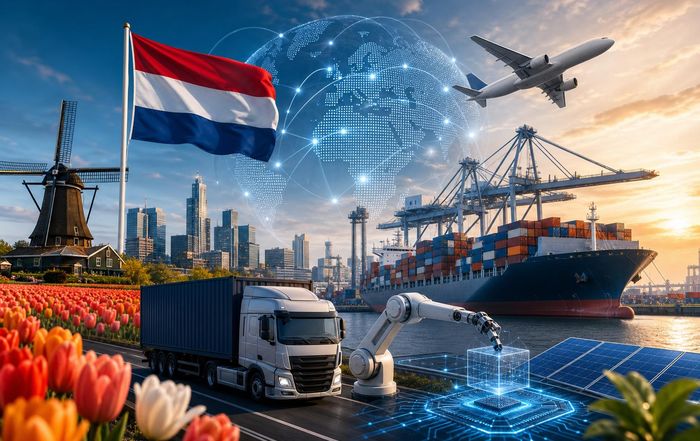
Netherlands Business Trends in Trade, Tech, and Logistics
The Netherlands punches far above its weight in global business. Despite a population of just over 17 million, it is consistently among the world's top trading nations, a key European tech hub, and one of the most advanced logistics ecosystems on the continent. As supply chains, digital technologies, and sustainability pressures reshape international commerce, the Dutch economy offers an instructive snapshot of how trade, tech, and logistics are converging.
This new article examines the most important business trends driving that convergence, with a focus on what they mean for companies trading with, investing in, or competing against Dutch firms.
Trade: From Traditional Gateway to Strategic Rebalancing
For decades, the Netherlands has branded itself as "Europe's gateway" - a role underpinned by the Port of Rotterdam, Port of Amsterdam, and Schiphol Airport. That role is evolving under the combined impact of geopolitics, EU regulation, and energy transition.
According to the World Trade Organization, the Netherlands consistently ranks among the top ten global merchandise traders, both in exports and imports, when intra-EU trade is included. A large share of this is so-called "re-exports": goods imported, processed minimally or not at all, and then shipped on to other EU markets. The Netherlands Bureau for Economic Policy Analysis (CPB) estimates that re-exports account for roughly half of Dutch exports by value, but with much lower margins than domestically produced exports. As global growth slows and supply chains become more regionalized, Dutch policymakers and businesses are increasingly focused on shifting from pure throughput to higher-value activities such as advanced manufacturing, services, and digital trade.
At the same time, EU sanctions on Russia, tensions with China, and industrial policy in the United States and Europe are forcing Dutch firms to rethink their exposure. High-tech trade is especially sensitive: the Dutch government has imposed export controls on certain advanced semiconductor manufacturing equipment made by ASML, following pressure from the United States and coordination with EU partners. This has turned a previously niche policy area-dual-use export control-into a board-level concern for Dutch technology and logistics companies.
For international businesses, the Netherlands remains a highly attractive base for European operations, but the value proposition is shifting. The country still offers strong access to the EU single market, a dense network of trade agreements via the EU, and a sophisticated services sector in areas such as banking, insurance, and professional services. However, higher energy costs, stricter nitrogen and environmental rules, and a political backlash against some tax structures are changing the calculus for highly mobile, tax-sensitive capital. These shifts connect directly to broader themes we cover in areas like global business, economy, and investment.
Tech: Deep Tech Strength Meets Digital Transition Challenges
The Netherlands has a distinctive technology profile: a world-class deep-tech and semiconductor ecosystem, strong applied research, and a thriving startup scene, but also digitalization gaps in some traditional sectors.
The standout example is ASML, the world's only supplier of extreme ultraviolet (EUV) lithography machines used to produce the most advanced chips. ASML's success is rooted in decades of collaboration between Dutch industry, universities, and public research bodies such as TNO and Eindhoven University of Technology. The Dutch government's National Growth Fund has earmarked billions of euros for innovation in key domains including semiconductors, AI, and quantum technology, underlining how central high-tech manufacturing has become to the country's long-term strategy. The European Commission's Chips Act also reinforces the Netherlands' role in Europe's semiconductor value chain, particularly in equipment and materials.
Beyond semiconductors, the Netherlands is an important European hub for artificial intelligence research and application. Amsterdam and Delft host strong AI labs, and the national initiative AI Coalition (NL AIC) brings together companies, knowledge institutions, and government to accelerate adoption in sectors such as logistics, agriculture, healthcare, and finance. The country has been closely involved in shaping and preparing for the EU AI Act, which imposes risk-based obligations on AI systems and will directly affect Dutch and foreign firms operating in the market. Businesses working with AI, whether in the Netherlands or abroad, will need to track these regulatory developments alongside the broader trends we cover on artificial intelligence and technology.
However, the tech story is not uniformly positive. The European Commission's Digital Economy and Society Index (DESI), which tracked EU digital performance until 2023, consistently ranked the Netherlands among the top performers in connectivity and digital public services, but highlighted challenges in digital skills and SME digitalization. Many Dutch small and mid-sized firms in manufacturing, construction, and traditional services still lag in adopting cloud, data analytics, automation, and cybersecurity best practices. This creates a two-speed economy: globally competitive high-tech champions on one side and slower-moving mid-market companies on the other.
This gap is also visible in fintech and crypto. Amsterdam is home to several notable fintechs, and the Netherlands has been an early mover in open banking and instant payments via the SEPA framework and the Dutch iDEAL system. At the same time, the Dutch Central Bank (DNB) has taken a relatively strict stance on crypto service providers, enforcing EU rules such as MiCA and anti-money-laundering requirements. For firms in digital finance, the Netherlands offers a sophisticated but tightly regulated environment, intersecting with themes in banking, crypto, and stock markets.
Logistics: Europe's Testbed for Smart and Sustainable Supply Chains
Logistics is where Dutch advantages in geography, infrastructure, and technology converge most clearly. The Port of Rotterdam is Europe's largest seaport by throughput, handling around 440 million tonnes of cargo annually in recent years, according to the port authority. It brands itself as a "smart port" and has been investing heavily in automation, data platforms, and energy transition. Rotterdam's Port Community System, managed by Portbase, connects thousands of companies and government agencies, enabling real-time data exchange across the logistics chain. The port is also a pilot site for digital twins, autonomous shipping trials, and AI-based optimization of terminal operations.
Schiphol Airport plays a similar role in air cargo and passenger connectivity, although it has faced capacity constraints and environmental scrutiny, including proposed limits on flight movements to reduce noise and emissions. These pressures are pushing Dutch logistics players to focus on efficiency, modal shift (from road to rail and inland waterways), and value-added services such as cold chain, pharmaceuticals logistics, and high-value electronics handling.
Sustainability is now a central driver. The Netherlands has legally binding climate targets aligned with the EU Green Deal, aiming for significant emissions reductions by 2030 and climate neutrality by 2050. Logistics is being reshaped by measures such as the EU Emissions Trading System (ETS) extension to maritime, fuel taxation changes, and stricter nitrogen emissions rules that affect infrastructure projects. Rotterdam is positioning itself as a major hub for green hydrogen, biofuels, and CO₂ transport and storage, including projects like Porthos, which will store captured industrial CO₂ under the North Sea. These initiatives are closely followed by companies looking to decarbonize supply chains and align with broader shifts we cover in sustainable business and innovation.
The Dutch government and industry are also promoting "synchromodal" transport-dynamically switching between road, rail, and water based on real-time conditions-to reduce congestion and emissions. Inland ports such as Venlo and Tilburg, combined with dense barge and rail connections into Germany and beyond, are key to this strategy. For global manufacturers and retailers, this makes the Netherlands not just a gateway, but a testbed for digitally enabled, low-carbon logistics models.
Labor Market, Talent, and the Cost of Doing Business
No analysis of Dutch business trends is complete without examining the labor market and operating environment. The Netherlands combines relatively high wages and living standards with strong productivity and labor participation, but faces acute talent shortages in several sectors.
The Dutch statistical office (CBS) has reported historically low unemployment rates in recent years, with tight labor markets particularly in IT, engineering, healthcare, education, and logistics operations. Employers compete fiercely for software developers, data scientists, and AI specialists, pushing up wages and benefits. The Dutch "30% ruling," which offers a tax-free allowance to certain highly skilled migrants, has been an important tool in attracting international talent, but it has been politically contentious and subject to tightening over time. Immigration, housing shortages, and pressure on public services have become central political issues, which could influence future talent policy.
On the other hand, the Netherlands offers a relatively predictable regulatory framework, strong worker protections, and a culture of social dialogue through employer associations and trade unions. Remote and hybrid work have been widely adopted, especially in knowledge-intensive sectors. For international investors, the combination of high labor costs and high productivity demands careful assessment of where in the value chain to locate activities: high-skill R&D, design, and regional management often make more sense than labor-intensive operations.
The tight labor market is also accelerating automation and AI adoption in logistics, manufacturing, and services. Warehouses in and around Rotterdam and Venlo increasingly deploy automated storage and retrieval systems, robotics, and AI-driven planning software to cope with worker shortages and cost pressures. This dynamic connects directly to broader employment and technology themes explored in our coverage of employment and business.
Tax, Regulation, and the Changing Investment Climate
Historically, the Netherlands has been known for its attractive tax regime, extensive treaty network, and advance tax rulings that allowed multinationals to structure international operations efficiently. This reputation has drawn scrutiny from the OECD, the European Commission, and NGOs concerned about tax avoidance. In response, the Dutch government has implemented a series of reforms, including withholding taxes on certain interest and royalty flows to low-tax jurisdictions, implementation of OECD BEPS measures, and support for the global minimum corporate tax (Pillar Two).
These changes, combined with EU-wide initiatives such as DAC6 (mandatory disclosure of cross-border tax arrangements) and new transfer pricing guidance, are reducing the scope for purely tax-driven structures. For multinational groups, the Netherlands remains an important holding, finance, and IP location, but the emphasis is shifting toward genuine substance-real activities, staff, and decision-making-rather than mailbox entities.
Regulatory complexity is also increasing in other areas. The EU's Corporate Sustainability Reporting Directive (CSRD) will require many large Dutch and foreign companies with operations in the EU to provide detailed environmental, social, and governance (ESG) disclosures. The EU Carbon Border Adjustment Mechanism (CBAM) will affect importers of certain carbon-intensive goods, many of which enter Europe via Dutch ports. Meanwhile, the Digital Services Act (DSA) and Digital Markets Act (DMA) are reshaping the landscape for digital platforms and online services, many of which run European operations out of Amsterdam or other Dutch cities.
For investors and corporate planners, the message is clear: the Netherlands offers a sophisticated, rules-based environment, but success increasingly depends on robust compliance, ESG integration, and the ability to navigate overlapping EU and national regulations rather than simply exploiting tax advantages.
Sector Spotlights: Where Trade, Tech, and Logistics Intersect
Several Dutch sectors illustrate how trade, technology, and logistics trends reinforce one another.
One is high-tech manufacturing and equipment, centered in the Brainport Eindhoven region. Companies like ASML, NXP, and a dense network of precision engineering suppliers form a globally competitive cluster. Their success relies on just-in-time delivery of specialized components, highly skilled talent, and close collaboration with research institutes. Supply chain resilience has become a strategic priority, with firms diversifying suppliers, increasing inventory of critical parts, and investing in supply chain visibility tools.
Another is agri-food and horticulture. The Netherlands is one of the world's largest agricultural exporters by value, despite its small land area, thanks to intensive greenhouse cultivation, advanced breeding, and high-tech logistics. The "Westland" greenhouse region and the Food Valley cluster near Wageningen University showcase precision agriculture, robotics, and data-driven supply chains. Yet the sector faces intense pressure over nitrogen emissions, land use, and animal welfare, prompting a push toward more sustainable, circular, and plant-based production models.
A third is offshore energy and maritime services. Dutch companies play leading roles in offshore wind installation, dredging, and maritime engineering. As North Sea countries ramp up offshore wind targets and explore hydrogen and carbon capture infrastructure, Dutch ports and shipyards stand to benefit. These projects require sophisticated logistics for large components, specialized vessels, and complex cross-border coordination-areas where Dutch firms have long experience.
Finally, digital and creative industries in Amsterdam and other cities are increasingly export-oriented, from gaming and media to SaaS platforms and cybersecurity. They leverage the Netherlands' strong connectivity, English proficiency, and favorable business environment, while relying on global cloud infrastructure and cross-border data flows that are now subject to stricter privacy and data-transfer rules under instruments such as the EU-US Data Privacy Framework.
What International Businesses Should Watch
For companies trading with, investing in, or partnering out of the Netherlands, several themes deserve close attention over the next few years.
First, supply chain resilience and regionalization will continue to shape the role of Dutch ports and logistics hubs. Expect more nearshoring and friend-shoring within Europe, with the Netherlands acting as both a consolidation point and a laboratory for digital, low-carbon logistics solutions. Firms should evaluate how Dutch infrastructure can support more resilient inventory strategies and multi-modal transport options.
Second, regulation of technology and sustainability is tightening. AI, data, and digital platforms are now subject to detailed EU rules, while climate and ESG regulations are reshaping investment, reporting, and trade. Businesses using Dutch entities or infrastructure to serve the EU market will need to integrate compliance into product design, data governance, and supply chain planning from the outset.
Third, talent and productivity will be decisive. The Netherlands offers access to highly skilled workers and a strong research ecosystem, but labor is scarce and expensive. Automation, AI, and process optimization are not optional add-ons but central to maintaining competitiveness, particularly in logistics, manufacturing, and services.
Fourth, the investment climate is becoming more selective. The Netherlands remains one of Europe's most attractive business locations, but the days of easy tax arbitrage and lightly regulated growth are over. Investors who bring real activities, innovation, and sustainable practices are more likely to find stable support from policymakers and local stakeholders.
For executives and analysts following global trade, technology, and supply chain developments, the Netherlands functions as an early indicator of broader European trends. Developments in Dutch ports, tech clusters, and regulatory policy often foreshadow changes that will later spread across the EU. Tracking these shifts alongside more key news and market dynamics can offer valuable insight into where international business is heading next.
