
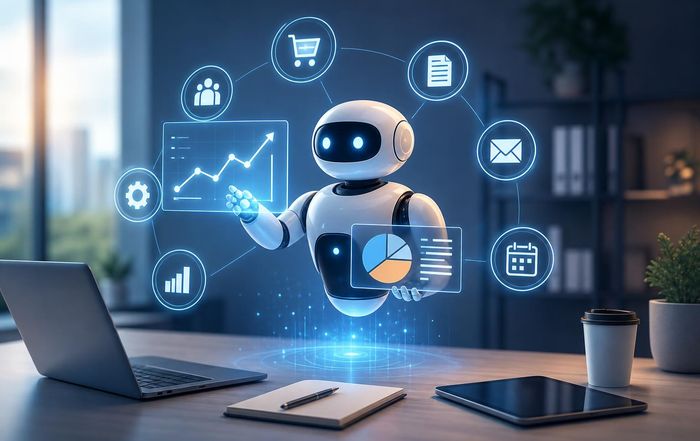
How AI Agents Are Reshaping Everyday Business Operations
Artificial intelligence has moved from experimental pilot projects to the center of daily business operations, and nowhere is this more visible than in the rapid rise of AI agents. These systems, which can perceive context, make decisions, and take actions across digital environments with limited human intervention, or potentially risky with no intervention at all, are transforming how organizations of all sizes operate, compete, and grow. For most of our well informed community, understanding how AI agents are quietly rewiring the operational backbone of companies worldwide is no longer optional; it is becoming a core element of strategic literacy in modern business.
From Static Tools to Autonomous Agents
Early enterprise AI largely revolved around static models embedded in specific applications: demand forecasting models in supply chains, recommendation engines in e-commerce, or fraud detection systems in banking. These tools were powerful but narrow, often locked into single-use cases and requiring extensive human orchestration. The current wave of AI agents represents a structural shift away from isolated models toward systems that can sense, reason, and act across multiple tools and workflows.
AI agents typically combine large language models, retrieval systems, planning components, and connectors to business applications such as CRM, ERP, and communication platforms. Frameworks like OpenAI's tools ecosystem, Google's Vertex AI Agent Builder, Microsoft's Azure AI Studio, and open-source projects such as LangChain and AutoGen have made it easier for enterprises to build agents that can interact with APIs, trigger workflows, and collaborate with human teams.
Unlike traditional chatbots, which primarily answer questions, modern AI agents can execute multi-step tasks, monitor systems, and adapt to feedback. This evolution is particularly relevant to the business and technology coverage that BizFactsDaily provides, because it marks a transition from AI as a passive advisor to AI as an operational teammate.
Readers can explore more about this shift in applied AI on the BizFactsDaily artificial intelligence and technology sections, where the focus is increasingly on deployed, real-world systems rather than theoretical potential.
Customer Service and Front-Office Transformation
Customer-facing operations have become one of the earliest and most visible beneficiaries of AI agents. Companies in sectors ranging from retail and travel to banking and telecom are deploying AI-driven virtual agents that handle inquiries, resolve issues, and even complete transactions across voice, chat, and email channels.
According to research from McKinsey & Company, generative AI and AI agents in customer operations can reduce handling times and deflect a substantial proportion of routine contacts, while improving first-contact resolution when integrated with knowledge bases and back-end systems. Studies from Gartner indicate that a growing share of customer service interactions are being handled fully or partially by AI-enabled systems, with the proportion expected to rise significantly as organizations embed agents more deeply into their customer relationship management platforms.
Modern AI agents in customer service no longer rely solely on scripted flows. They can access real-time account data, interpret intent, and perform actions such as updating billing details, modifying subscriptions, or initiating refunds, subject to appropriate security and authorization controls. Platforms like Salesforce Einstein and ServiceNow Now Assist integrate these capabilities directly into enterprise workflows, allowing agents to collaborate with human representatives who can step in when edge cases or high-stakes decisions arise.
For executives tracking the intersection of customer experience and operational efficiency, the BizFactsDaily business and marketing pages provide context on how these AI-powered front offices are reshaping brand perception, loyalty, and revenue.
Back-Office Automation and Process Orchestration
While customer-facing AI agents attract much of the attention, some of the most profound operational changes are occurring behind the scenes. In finance, HR, procurement, and compliance, AI agents are increasingly orchestrating workflows that previously required manual coordination across teams and systems.
In finance and accounting, AI agents are being deployed to reconcile transactions, flag anomalies, prepare draft reports, and assist with regulatory documentation. Deloitte and PwC have both published analyses describing how AI agents, when combined with robotic process automation (RPA), can handle complex, multi-system workflows that traditional RPA alone struggled with, such as interpreting unstructured documents or responding to changing business rules. Learn more about how these trends intersect with macroeconomic conditions in the BizFactsDaily economy coverage.
In HR, AI agents help manage candidate screening, onboarding workflows, and internal mobility processes. Systems from providers like Workday and SAP SuccessFactors increasingly embed generative AI assistants that can draft job descriptions, answer employee policy questions, and coordinate interviews. Research from the World Economic Forum and the International Labour Organization emphasizes both the productivity potential and the need for careful governance to avoid bias and ensure transparency in employment-related decisions, a theme that aligns closely with the BizFactsDaily employment reporting.
In procurement and supply chain operations, AI agents assist with vendor communication, purchase order processing, and exception handling. For example, agents can monitor supplier portals, compare quotes, and alert human managers to risks such as delays or pricing anomalies. MIT Sloan Management Review has highlighted the emergence of "cognitive supply chains," where AI agents continuously learn from historical data and real-time signals to optimize ordering, inventory, and logistics.
AI Agents in Banking, Investment, and Financial Markets
The financial sector has historically been an early adopter of automation, and AI agents are now extending that tradition into more sophisticated territory. In retail and commercial banking, AI agents power intelligent virtual assistants that help customers manage accounts, navigate products, and obtain tailored financial education. Organizations such as JPMorgan Chase, Bank of America, and HSBC have invested heavily in AI-driven digital channels, and industry analyses from Accenture and Oliver Wyman suggest that AI agents are becoming a core component of modern banking architecture.
On the operations side, AI agents assist with anti-money laundering (AML) monitoring, fraud detection, and credit risk assessment, often working in tandem with human analysts. Regulatory bodies, including the Bank for International Settlements and the European Banking Authority, have published guidance on the responsible use of AI, emphasizing explainability, data governance, and model risk management. Readers interested in these dynamics can explore the BizFactsDaily banking section, where the interplay between innovation and regulation is a recurring theme.
In investment management and stock markets, AI agents are being deployed for research assistance, portfolio monitoring, and trade execution support. While fully autonomous trading algorithms have existed for years, the new generation of agents differs in its ability to synthesize unstructured information, generate natural language insights, and interact with portfolio managers in real time. BlackRock, Vanguard, and other major asset managers have publicly discussed their use of AI for risk analytics and research augmentation, though they typically remain cautious about fully delegating investment decisions to autonomous agents.
Market infrastructure providers and exchanges are also exploring AI agents for surveillance, compliance, and market integrity functions. Reports from organizations such as IOSCO and ESMA highlight both the opportunities and systemic risks associated with highly automated market environments. The totally original, and independent stock markets and investment pages follow these developments closely, emphasizing practical implications for institutional and retail investors.
AI Agents as Innovation Engines and Developer Co-Pilots
For technology and product teams, AI agents have become powerful accelerators of innovation. Developer-focused tools such as GitHub Copilot, Amazon CodeWhisperer, and Google's Gemini Code Assist act as coding companions, suggesting implementations, generating tests, and helping engineers navigate complex codebases. These systems are evolving into more autonomous agents that can plan and execute multi-step development tasks, create prototypes, and integrate with CI/CD pipelines under human supervision.
Innovation labs and startups across the United States, Europe, and Asia are building specialized agents for tasks such as data engineering, MLOps, and infrastructure management. Open-source ecosystems on platforms like GitHub and research shared via arXiv show a rapid proliferation of agentic frameworks, multi-agent collaboration architectures, and tools for evaluating the reliability and safety of complex AI systems.
For founders and innovators, this represents a dual opportunity: AI agents can both enhance their internal development velocity and form the basis of new products and services. The always up-to-date innovation and founders sections feature stories that illustrate how entrepreneurs in regions from North America and Europe to Asia-Pacific and Africa are leveraging AI agents to compete with larger incumbents, often by focusing on niche verticals or underserved markets.
Operational Impact on Small and Medium-Sized Enterprises
While large corporations often dominate headlines, small and medium-sized enterprises (SMEs) are experiencing some of the most transformative day-to-day changes from AI agents. Cloud-based platforms now offer embedded AI assistants that handle tasks such as bookkeeping, scheduling, customer communication, and inventory management without requiring in-house data science expertise.
Services from companies like Intuit, Shopify, and HubSpot integrate AI agents directly into accounting, e-commerce, and marketing workflows. For instance, an AI agent can reconcile transactions in a small retailer's accounting system, respond to routine customer inquiries on the website, and generate targeted email campaigns based on recent purchasing behavior. OECD and World Bank reports on SME digitalization emphasize that access to such tools can narrow productivity gaps between smaller firms and large enterprises, particularly in emerging markets where skilled labor and capital are scarce.
This democratization safety plus control of AI capabilities aligns closely with the mission of BizFactsDaily, which aims to provide accessible, credible insights for business leaders at every scale. People can find related stories in the platform's business and global sections, where case studies from diverse regions highlight the practical steps SMEs are taking to adopt AI agents responsibly.
AI Agents in Crypto, Digital Assets, and Web3
The convergence of AI agents with crypto and decentralized technologies is emerging as a frontier area of experimentation. Developers in the Web3 ecosystem are exploring scenarios where AI agents can act as autonomous economic actors, interacting with smart contracts, decentralized finance (DeFi) protocols, and tokenized assets.
Projects in this space range from AI-driven trading bots operating on decentralized exchanges to agents that manage on-chain treasuries or participate in governance processes. Research from organizations such as Ethereum Foundation contributors and academic groups at universities like Stanford and UCL examines both the technical feasibility and the governance challenges of autonomous agents controlling digital funds or voting power.
At the same time, regulators including the U.S. Securities and Exchange Commission, the European Securities and Markets Authority, and authorities in jurisdictions such as Singapore and Switzerland are scrutinizing AI-augmented trading strategies and automated advisory services to ensure investor protection. The intersection of AI agents and digital assets remains a fast-moving and sometimes contentious area, and BizFactsDaily tracks it closely in the crypto and news sections, emphasizing verifiable developments and regulatory clarity.
Employment, Skills, and the Human-AI Partnership
The rise of AI agents inevitably raises questions about employment, skills, and the future of work. Analyses by OECD, McKinsey Global Institute, and PwC converge on the view that AI, including agentic systems, will significantly reshape task composition within jobs, with some roles experiencing automation of routine components and others seeing substantial augmentation.
Rather than a simple story of job loss, the emerging evidence points to a reconfiguration of work where humans increasingly focus on judgment, creativity, relationship-building, and complex problem-solving, while AI agents handle repetitive, data-intensive, and coordination-heavy tasks. For example, a customer service professional may spend less time on password resets and more time on nuanced retention conversations, supported by an AI agent that surfaces relevant insights in real time.
These dynamics underscore the importance of reskilling and upskilling initiatives. Organizations such as Coursera, edX, and Udacity offer specialized programs on AI literacy, data skills, and prompt engineering, often developed in partnership with leading universities and technology companies. Governments in regions including the European Union, Singapore, and Canada have launched national AI skills strategies and funding schemes to support workforce transitions, recognizing that inclusive adoption is critical for long-term economic resilience.
For professional followers, the employment and economy pages provide a grounded perspective on how AI agents are affecting labor markets, wages, and productivity across different sectors and countries, with an emphasis on evidence-based analysis rather than hype.
Governance, Risk, and Trust in Agentic Systems
As AI agents take on more operational responsibility, questions of governance, risk management, and trust move to the forefront. Enterprises adopting AI agents must address issues such as data privacy, security, model bias, reliability, and accountability for decisions made by semi-autonomous systems.
Regulatory frameworks are evolving in response. The European Union's AI Act, which has been advancing through legislative processes, introduces risk-based requirements for AI systems, including transparency obligations and oversight mechanisms for high-risk applications. In the United States, agencies such as the Federal Trade Commission and Consumer Financial Protection Bureau have issued guidance on the use of AI in consumer-facing services, emphasizing fairness, explainability, and non-discrimination. International bodies like the OECD and UNESCO have published AI principles that stress human rights, safety, and accountability.
From a technical standpoint, research communities and industry consortia are investing heavily in tools for monitoring and controlling AI agents. Organizations such as NIST in the United States are developing frameworks for AI risk management, while academic and industry labs explore methods for alignment, red-teaming, and robust evaluation. Learn more about responsible innovation and sustainable approaches to technology in the sustainable and innovation sections.
Trust is not only a regulatory or technical issue; it is also a matter of organizational culture and communication. Companies that succeed with AI agents tend to invest in clear policies, employee training, and transparent user experiences that explain when and how AI is involved in decisions. This focus on explainability and user empowerment helps mitigate fears and fosters a collaborative human-AI relationship.
Global Perspectives and Regional Dynamics
AI agents are reshaping business operations across continents, but adoption patterns and priorities vary by region. In North America, particularly the United States and Canada, a vibrant ecosystem of startups, cloud providers, and enterprise adopters is driving rapid experimentation, with strong venture capital interest in agent-based platforms. In Europe, countries such as Germany, France, the Netherlands, and the Nordics are emphasizing responsible and regulated AI adoption, balancing innovation with data protection and ethical considerations.
In Asia, nations including China, Japan, South Korea, and Singapore are investing heavily in AI infrastructure and industry applications, often through coordinated public-private initiatives. For instance, Singapore's national AI strategy highlights the integration of AI into key sectors such as finance, logistics, and healthcare, with a strong focus on governance and international standards. Emerging markets in regions like Africa and South America are exploring AI agents as a way to leapfrog legacy infrastructure, particularly in areas such as mobile banking, agri-tech, and public services.
International organizations like the World Bank, IMF, and UN emphasize that inclusive access to AI capabilities, digital infrastructure, and skills development will be critical to ensuring that the benefits of AI agents are broadly shared rather than concentrated in a few advanced economies. The global lens that BizFactsDaily brings through its global and news coverage helps readers situate local developments within these wider geopolitical and economic trends.
Strategic Guidance for Business Leaders
For executives, founders, and investors, the rise of AI agents poses both a challenge and an opportunity. The challenge lies in navigating a fast-moving landscape of technologies, vendors, and regulatory expectations while avoiding fragmented experiments that fail to scale. The opportunity is to reimagine core operations, customer experiences, and business models in ways that were previously impractical or uneconomical.
Several themes recur in the experiences of organizations that have successfully integrated AI agents into everyday operations. They begin with clear business objectives rather than technology for its own sake, identifying specific pain points or value pools where agents can deliver measurable impact. They invest in high-quality data infrastructure and governance, recognizing that AI agents are only as effective and trustworthy as the information they can access. They adopt a human-centered design approach, involving employees and customers in the design, testing, and refinement of agentic workflows. They also treat AI adoption as an ongoing capability-building journey, not a one-time project, continuously updating models, policies, and skills as technologies and regulations evolve.
Investors watching this space are paying close attention to companies that can demonstrate not just AI capabilities, but defensible advantages in data, domain expertise, and integration with critical workflows. The investment and stock markets sections regularly highlight how public and private markets are valuing firms that effectively harness AI agents, from established technology leaders to emerging specialists.
A New Operational Era
As the world moves deeper into the second half of the 2020s, AI agents are no longer a speculative technology; they are becoming embedded in the operational fabric of enterprises around the globe. They answer customer questions, reconcile financials, support developers, monitor risks, and increasingly coordinate complex workflows that span multiple systems and teams. Their impact is visible in productivity statistics, customer satisfaction metrics, and the competitive dynamics of entire industries.
For educated, professional business leaders, the key question is not whether AI agents will reshape everyday business operations, but how quickly and in what form this transformation will reach their own organizations, sectors, and regions. By staying informed through reliable sources such as OECD, World Economic Forum, MIT Sloan Management Review, Harvard Business Review, NIST, and the in-depth analysis available across BizFactsDaily, business leaders can approach this transition with confidence rather than anxiety.
The rise of AI agents is ultimately a story of augmentation: a rebalancing of human and machine roles that, when guided by sound governance and a commitment to shared prosperity, can unlock new levels of innovation, inclusivity, and resilience. Organizations that embrace this shift thoughtfully, with a clear-eyed view of both opportunities and risks, are likely to find themselves not just adapting to the future of work and business, but actively shaping it.
